Stacy F. Kaufeld, M.A.
Having spent much of my youth in British Columbia, including summers with my maternal grandparents on Vancouver Island and my paternal grandparents in Kitimat, I had never before heard of the plight of Japanese Canadians. During my first year of university, in a survey course on Canadian history, I was introduced to the Japanese Canadian experience. It was only in 1998, my third year at the University of Victoria, where I wrote a paper on the internment of Japanese Canadians during World War II.
Even at that time, ten years after Prime Minister Brian Mulroney signed the historic Redress Agreement with the National Association of Japanese Canadians, I was surprisingly not shocked to learn how many people failed to see the underlying racist sentiment in Canada’s wartime policy and the public’s attitude towards Japanese Canadians. The tendency to excuse Canada’s past systemic racism is understandable, Canadians choose instead to view themselves as morally superior and distinct. However, overlooking Canada’s negative history leads to a distorted historical interpretation that oversimplifies, romanticizes, and ultimately leaves citizens less knowledgeable about their nation’s past.
To be certain, discrimination against Japanese Canadians existed long before December 7, 1941. The Japanese experienced plenty of racism following their initial arrival in Canada in the late nineteenth century. First, Canadians believed the new arrivals would not nor could not assimilate to Canadian society. Second, after settling mostly on the west coast, the Japanese established businesses in Vancouver, became farmers, and played a significant role in the fishing industry; some argued that they were taking jobs from Canadians. Lastly, and especially after Pearl Harbor, the Canadians, including the authorities, suspected that the Japanese would be loyal to Japan and not to Canada.
A majority of the 22,000 Japanese living in Canada considered themselves to be Canadian. In fact, many were born in Canada and had never travelled to Japan, and others had naturalized after years of residency. They settled in Canada, established thriving business or had gainful employment, they raised families, and their kids attended school. They felt part of the community. Though racist attitudes persisted, they believed in Canada. Certainly, they trusted that their government and the law would protect them. As this book shows, however, the law was used to discriminate against and further marginalize Japanese Canadians.
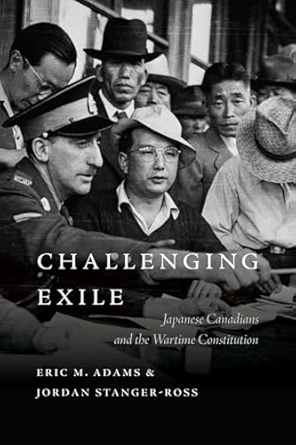
This is a legal history told through the personal journeys of many Japanese Canadians about the government’s effort “to banish to Japan as many Japanese Canadians as possible” (pg. 1). Much has been written about the history of evacuation and internment. These events remain crucial because they provide the context for what the authors described as “a cascade of injustice” through internment and into the post-war era. This significant contribution to this history examines the constitutional legitimacy of the War Measures Act, the dispossession of property, and the post-war Orders-in-Council, which raised critical questions about citizenship and national belonging.
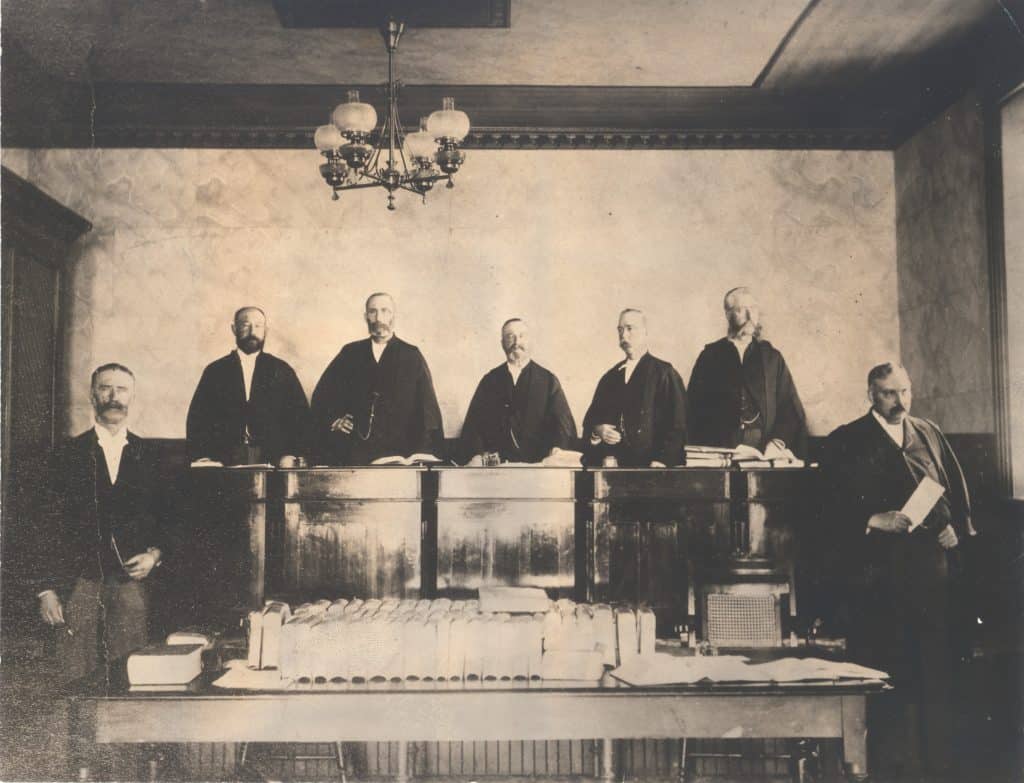
This book investigates the legal challenges that Japanese Canadians mounted in opposition to the government’s infringement on their legal and physical rights. To believe that Japanese residents meekly abandoned their homes and businesses, willing accepted the sale of their belongings, and simply agreed to be exiled to Japan is a misunderstanding of this dark period in Canadian history. At every stage, Japanese Canadians resisted and contested government orders. Legal disputes against the forced sale of property and belongings, as well as involuntary deportation to Japan were challenged in the Supreme Court of Canada and the Judicial Committee of the Privy Council (JCPC).
It was reasonable to expect that Japanese Canadians would resume their lives and reclaim their homes and businesses after the war, particularly given the government’s assurances that internment was temporary and that their possessions and property would be held in trust. This all changed when the Canadian government, under the authority of the War Measures Act, decided to renege on their promise and began to sell all Japanese possessions and property at a fraction of the actual value. The liquidation of property served no national security purpose, but it was steeped in racism. Selling their property and possessions was one way to ensure Japanese Canadians would not return to British Columbia’s coast.
Following the end of the War in the Pacific, authorities continued to insist their orders were necessary for national security. The authors, however, conclude that racism persisted as a factor in the government’s ongoing policy to extend exile. The government formulated a strategy to question the loyalty, identity, and citizenship of Japanese Canadians. They hoped to drive as many as possible to leave for Japan. Those who did not voluntarily return to Japan would be subjected to a loyalty test to determine who could remain in Canada. Those deemed disloyal would be deported to Japan regardless of citizenship status. And, for those remaining, they would be permanently barred from returning to British Columbia.
The courts, known for their deference to the government, had to decide two different cases addressing dispossession and forced exile. In both instances, government lawyers disputed the courts’ jurisdiction to question the authority of the government under the War Measures Act during a time of national emergency. Conversely, counsel representing the Japanese contended that the orders were invalid. Their arguments included, first, that there was an inadequate connection to national security, and second, a challenge as to whether the Act granted the government the authority to exile Canadian citizens.
At the time, Canadians believed the treatment of the Japanese was justified for national security purposes. The War Measures Act gave the government unlimited powers to act in the national interest during a state of emergency. World War II was undoubtedly a time of crisis, with national security becoming a top priority for both citizens and the government. Japan, as part of the Axis powers alongside Germany and Italy, stood against the Allies. However, Japanese Canadians experienced far harsher treatment than their German or Italian counterparts. While German and especially Italian immigrants to Canada in the early twentieth century did encounter discrimination, they were not subjected to the widespread marginalization and mass internment that Japanese Canadians endured during and after the war.
Balancing national security with the protection of personal liberties is never easy. Canadian authorities justified the removal of Japanese Canadians from the British Columbia coast as a national security concern. However, the Canadian government exploited fear to justify their continued treatment of Japanese Canadians that was not based on evidence of espionage or sabotage but was motivated and influenced by racism. Although authorities may have justified “evacuation” on grounds of national security, the dispossession of assets, postponement of return to British Columbia until 1949, and the imposition of exile cannot be substantiated by national security considerations.
Despite initial support for government policy, public opinion in Canada began turning against the continued deportation of Japanese Canadians. This difficult chapter in Canadian history sparked post-war debates on human and citizenship rights, minority protection, and prompted major policy reforms. Parliament, at the insistence of John Diefenbaker, began debating the introduction of the bill of rights to protect minorities, which became federal law in 1960 when he was Prime Minister. The Charter of Rights and Freedoms, enacted in 1982, further entrenched the protection and equality of minorities in the Canadian Constitution. Lastly, Brian Mulroney replaced the War Measures Act in 1988 with the much more limited Emergencies Act.
This well-researched book, from a legal perspective, illustrates the importance of abiding by the rule of law especially during times of great struggle. This foundational legal principle is necessary to ensure the protection of rights and human dignity for all citizens. The rule of law is greatly weakened when societies start enforcing laws selectively rather than applying them to everyone equally. This book exposes a period in Canadian history when the law, which is supposed to protect all citizens, was used to promote hate and racism. The apology and settlement in 1988 showed how civility can triumph over racism. Although Canada has made significant progress, race relations remain an ongoing and evolving challenge.